Heritage: The Earth's First Canvas
W
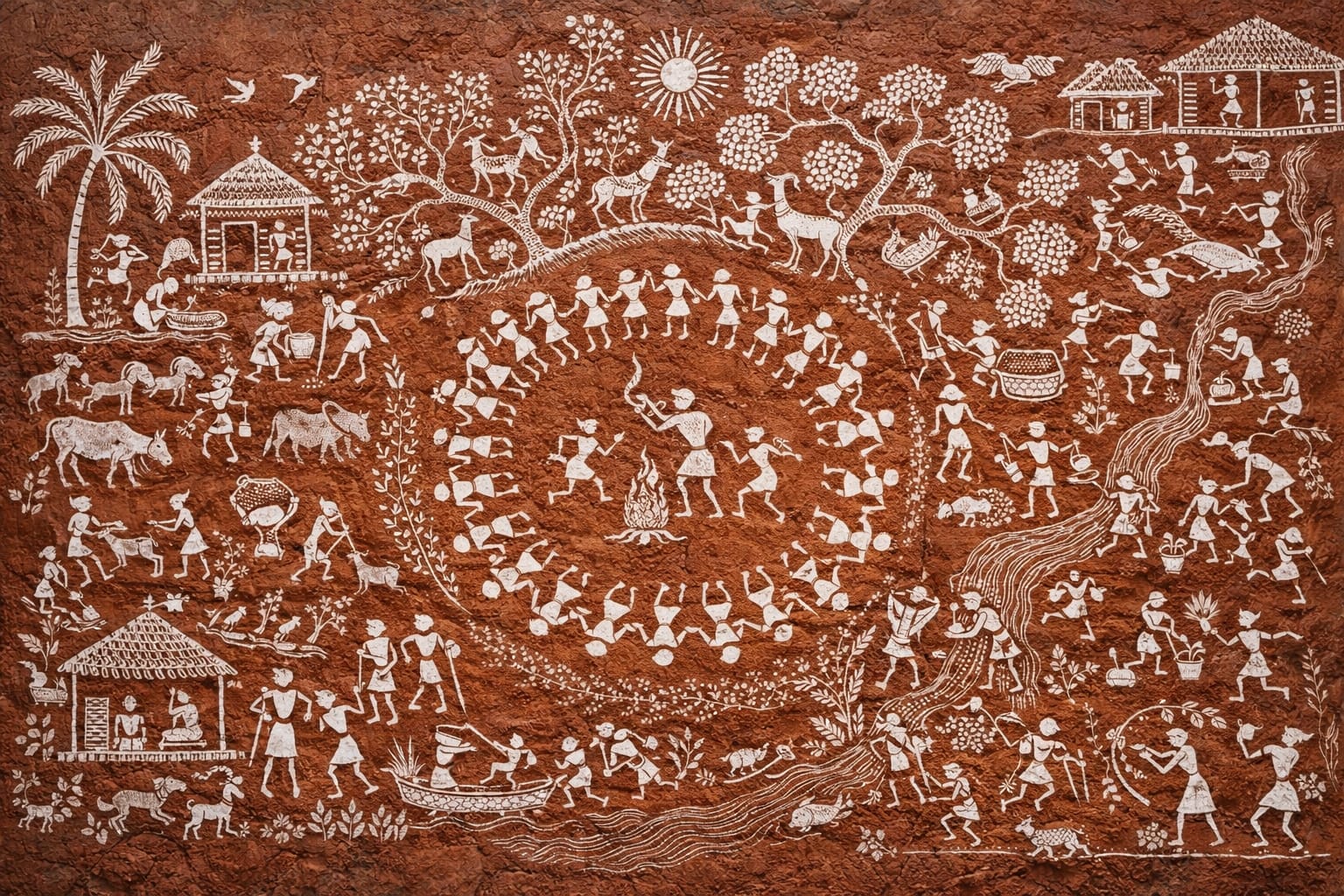
The walls of a Warli home are not merely boundaries; they are living chronicles. Painted with a simple paste of ground rice and water on a background of cow dung and red mud, this indigenous art from the Sahyadri mountains of India speaks a language that predates written history. It is a language of basic shapes—the circle, the triangle, and the square—each carrying a weight of cosmic significance.
Unlike the ornate court paintings of medieval India, Warli art is democratic and grounded. It does not depict gods in palaces; it depicts the rhythm of harvesting, the celebration of birth, and the profound silence of the forest. Heritage, for the Warli, is not a museum piece—it is a daily practice of acknowledging one's place within the larger tapestry of existence.
Connection: The Tarpa Dance & Collective Balance
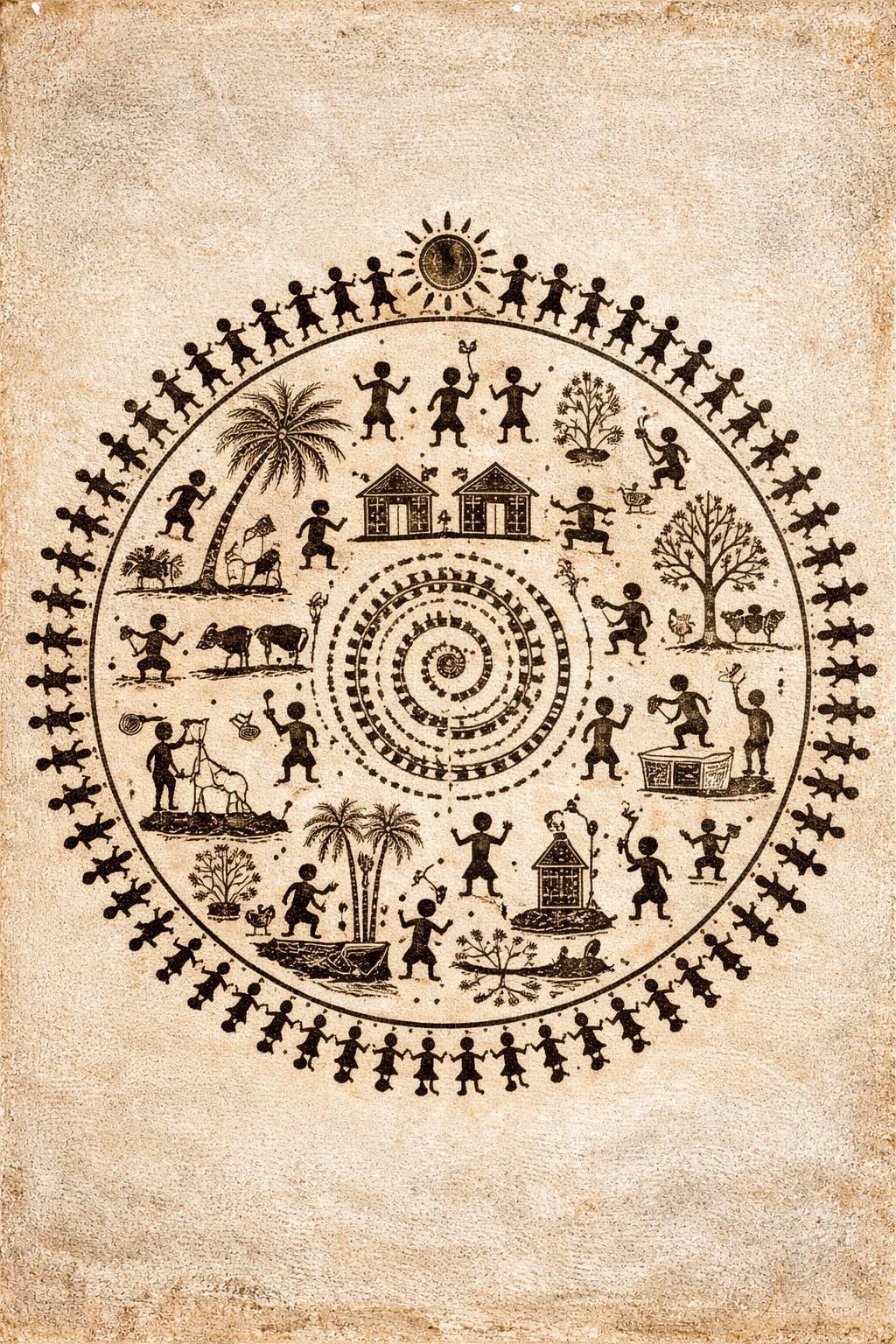
At the heart of Warli social life is the Tarpa Dance. As the sun sets, the village gathers. A musician plays the Tarpa—a wind instrument made from a dried gourd. The dancers intertwine their hands, forming a vast, swirling circle that moves in a rhythmic pulse.
The Circle
Cosmic Unity
The circle represents the Sun and the Moon. It symbolizes the infinite cycle of life and the interconnectedness of all living beings.
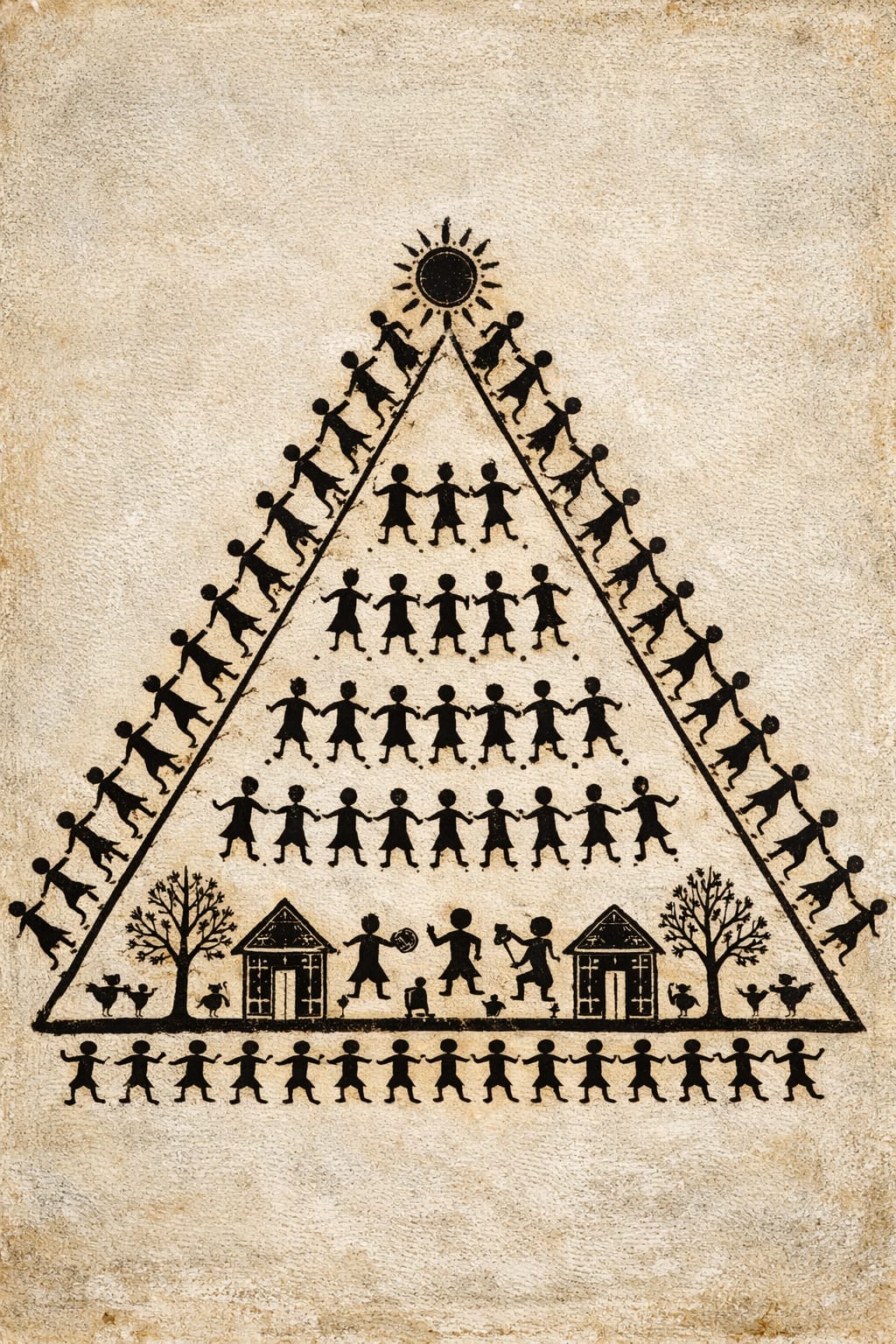
The Triangle
Stability
Derived from the shape of mountains and pointed trees, the triangle represents grounding and the connection between Earth and Sky.
Inside the Tarpa circle, there is no leader. Each person is vital to the movement of the whole. This is a visual metaphor for Social Cohesion—an understanding that individual wellness is inseparable from the wellness of the community and the land.
The Meditation of Repetition
In modern life, we are often overwhelmed by chaos and unpredictability. Warli art offers an ancient counter-narrative: The rhythm of repetition. By drawing the same geometric person, the same swirling wave, and the same steady mountain over and over, the artist enters a state of flow.
"Repetition is not boredom; it is a mental anchor. It is the steady heartbeat of the land translated into visual form."
This practice mirrors modern mindfulness. Connecting pattern repetition to stress reduction, the act of drawing Warli patterns acts as a meditative focus, slowing the breath and grounding the nervous system. You don't need to be an artist to feel this—try tracing a circle slowly, and notice the rhythm it creates in your mind.
Material Spotlight: Touched by Earth
The materials used in Warli art are sourced directly from the landscape, ensuring a physical and spiritual grounding.
Rice Paste
Symbol of sustenance and prosperity. Its white brilliance represents the light of life.
Geru (Red Soil)
The grounding foundation of the mountains. This clay provides the warm canvas for stories.
Bamboo Sticks
The flexible framework of the forest, used for instruments and structural details.